In a remarkable recognition of engineering prowess, China's South-to-North Water Diversion Middle Route Project has been named among the 2025 Global Top Ten Engineering Achievements, standing shoulder to shoulder with other world-changing infrastructure marvels. This prestigious acknowledgment comes as no surprise to those familiar with the project's monumental scale and transformative impact on water resource distribution in one of the world's most populous regions.
The selection committee, comprising international engineering experts and environmental scientists, highlighted the project's innovative approach to addressing one of humanity's most pressing challenges: water scarcity. What sets this achievement apart isn't merely its technical complexity, but its profound implications for sustainable development and regional stability. The project represents a paradigm shift in how nations can approach resource management on a grand scale.
Engineering on an unprecedented scale
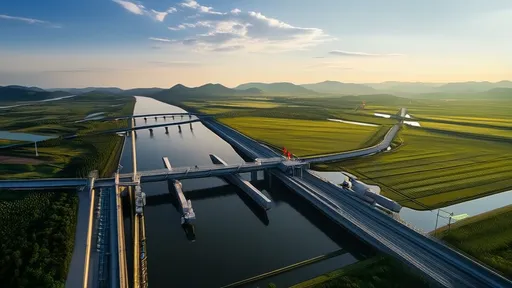
Stretching over 1,432 kilometers from the Danjiangkou Reservoir in Hubei Province to Beijing and Tianjin, the Middle Route Project constitutes one of the most ambitious water transfer initiatives ever undertaken. The sheer magnitude of the undertaking becomes apparent when considering that the channel crosses 1,774 watercourses, 219 roads, and 133 railways while traversing diverse geological conditions. Engineers had to account for elevation changes, seismic activity, and environmental preservation throughout the route.
The project's backbone features two massive aqueducts spanning the Yellow and Wei Rivers, each representing marvels of modern hydraulic engineering. These structures required innovative solutions to maintain water flow while accommodating navigation and ecological concerns. The crossing of the Yellow River alone presented challenges that demanded entirely new approaches to underwater tunnel construction, resulting in several patented technologies now being adopted worldwide.
Environmental considerations and ecological impact
Unlike many large-scale infrastructure projects of the past, the South-to-North Water Diversion Project incorporated environmental protection as a core design principle from its inception. The construction included extensive water quality monitoring systems, ecological restoration projects along the route, and sophisticated measures to protect local ecosystems. These efforts have not only minimized environmental disruption but have in many cases improved local ecological conditions.
The project's environmental management system has become a model for similar initiatives globally, demonstrating how large-scale engineering can coexist with environmental stewardship. Water quality remains consistently high throughout the transfer route, thanks to comprehensive protection measures including buffer zones, pollution control, and continuous monitoring. The achievement is particularly notable given that the water travels such a considerable distance while maintaining drinking water standards.
Social and economic transformation
The impact of the Middle Route Project extends far beyond engineering diagrams and technical specifications. For millions of residents in northern China, the project has fundamentally altered daily life and economic prospects. Cities that previously faced severe water shortages now enjoy reliable water supplies, enabling industrial development, agricultural stability, and improved living conditions.
In Beijing, where groundwater depletion had reached critical levels, the project has helped stabilize water tables and reduce reliance on over-exploited aquifers. The capital now receives approximately 70% of its municipal water through the diversion project, significantly easing water stress in the metropolitan area. Similar transformations have occurred in Tianjin and other cities along the route, where water security has catalyzed economic growth and urban development.
Technological innovations and global contributions
The project's selection among the world's top engineering achievements reflects not just its scale but its technological contributions to the global engineering community. Chinese engineers developed numerous innovations in tunneling, water treatment, and project management that are now being studied and adopted internationally. The project's success in managing such complex logistics across multiple provinces has set new standards for mega-project administration.
Particularly noteworthy are the advances in automated monitoring systems, which utilize artificial intelligence and big data analytics to optimize water flow, detect potential issues, and manage the entire system efficiently. These technological solutions have applications beyond water diversion projects, contributing to smarter infrastructure management across various sectors worldwide.
International recognition and future implications
The inclusion of the South-to-North Water Diversion Middle Route Project in the 2025 Global Top Ten Engineering Achievements places it in the company of other groundbreaking projects that are reshaping our world. This recognition underscores China's growing role in addressing global challenges through engineering excellence and large-scale infrastructure development.
International water management experts have noted that the project offers valuable lessons for other regions facing water scarcity issues. The successful implementation of such a complex system provides a blueprint for how nations might approach their own water resource challenges, particularly in the context of climate change and growing urban populations.
Sustainable development and long-term vision
What makes this achievement particularly significant is its alignment with sustainable development principles. The project was conceived not as a quick fix but as a long-term solution to regional water imbalance. Its design incorporates flexibility to adapt to changing climate patterns and evolving water needs, ensuring its relevance for generations to come.
The careful balancing of immediate water needs with environmental protection and future sustainability represents a new paradigm in infrastructure development. This approach has drawn praise from international development organizations and has influenced how other nations plan their own major infrastructure projects.
Cultural and historical context
The South-to-North Water Diversion Project represents the culmination of centuries of Chinese water management expertise, dating back to ancient irrigation systems and canal networks. Modern engineers built upon this rich heritage while incorporating cutting-edge technology, creating a synthesis of traditional wisdom and contemporary innovation.
This historical continuity adds depth to the engineering achievement, connecting it to China's long tradition of large-scale water management projects while demonstrating the country's capacity for technological advancement. The project stands as a testament to how engineering can build upon cultural heritage while pushing the boundaries of what's possible.
Looking forward: The project's continuing evolution
Even as the Middle Route Project receives global recognition, work continues to optimize its operations and expand its benefits. Ongoing research focuses on improving energy efficiency, enhancing water quality protection, and developing complementary projects that can further address water resource challenges in northern China.
The project's success has also inspired similar initiatives in other water-stressed regions around the world, creating a global community of practice around large-scale water transfer projects. This international knowledge sharing represents another dimension of the project's impact beyond its immediate geographical scope.
The recognition of the South-to-North Water Diversion Middle Route Project as one of 2025's top engineering achievements marks a significant milestone not just for China but for the global engineering community. It demonstrates humanity's capacity to address fundamental challenges through innovation, collaboration, and visionary planning. As water scarcity becomes an increasingly pressing global issue, the lessons from this monumental project will undoubtedly influence how societies worldwide approach one of our most vital resources.
By /Oct 21, 2025

By /Oct 20, 2025

By /Oct 20, 2025

By /Oct 21, 2025

By /Oct 20, 2025

By /Oct 21, 2025

By /Oct 21, 2025

By /Oct 21, 2025
By William Miller/Oct 20, 2025

By /Oct 21, 2025
By /Oct 21, 2025

By /Oct 20, 2025

By /Oct 20, 2025

By /Oct 21, 2025

By /Oct 20, 2025

By /Oct 21, 2025

By Joshua Howard/Oct 20, 2025

By /Oct 21, 2025
By /Oct 21, 2025

By /Oct 20, 2025